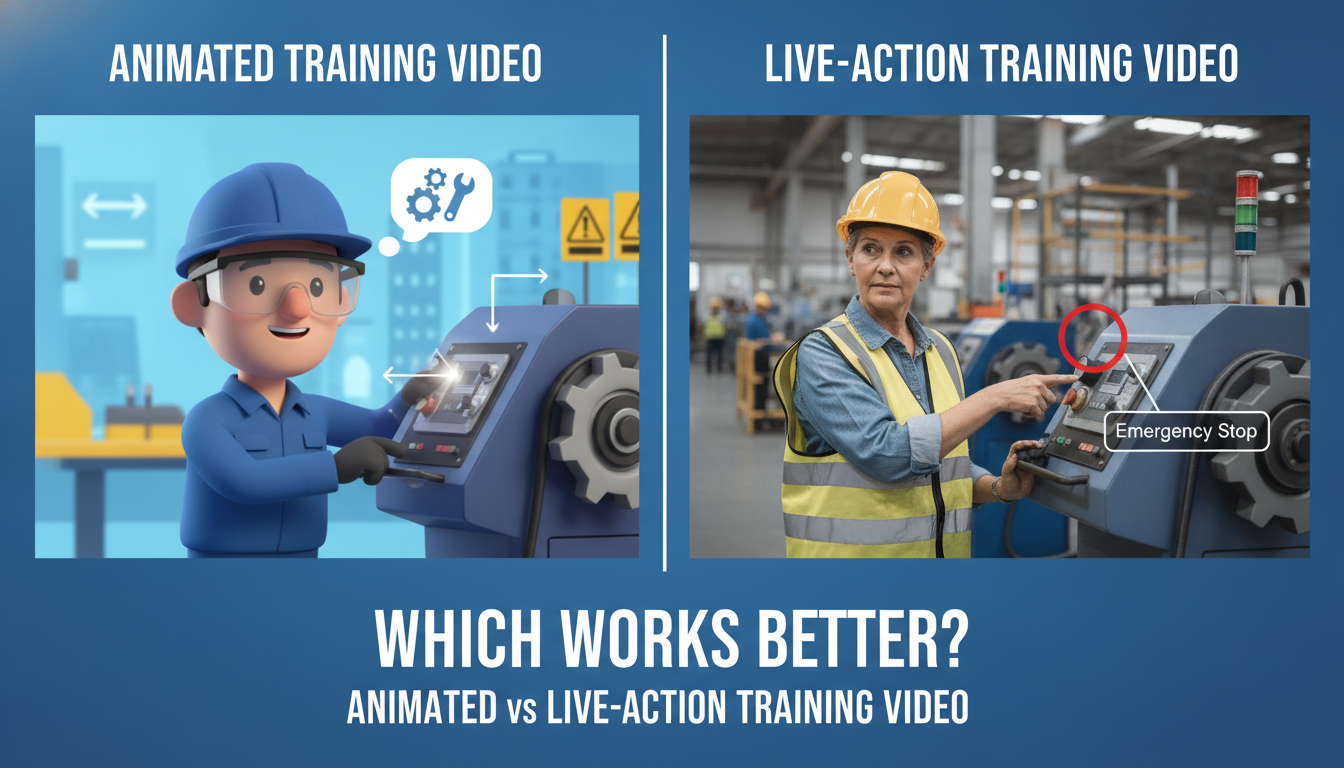
Choosing between animated vs live-action training video depends on your content, audience, and budget. Animated excels for abstract concepts, while live-action builds crucial human connection for soft
Deciding between an animated vs live-action training video often comes down to your content's nature, your audience's needs, and your budget and timeline. Both formats offer distinct advantages for learning and development leads, but the 'better' choice hinges on aligning with your specific training objectives.
The Core Dilemma: Animated vs. Live-Action
As an L&D lead, you're always looking for the most effective way to convey information, build skills, and engage your learners. The format of your training video plays a huge role in that. I've watched countless teams wrestle with this decision, and it's rarely a simple one-size-fits-all answer. It's about understanding what each format does best and where its limitations lie.
You might be rolling out a new software platform, introducing complex compliance regulations, or perhaps refining leadership communication skills. Each of these scenarios benefits from a different visual approach. Let's break down when to lean into animation and when to bring in the cameras for a live-action shoot.
When Animated Training Videos Shine
Animated training videos are a powerful tool for explaining abstract concepts, visualizing data, or simplifying complex processes without needing real-world physical sets or actors. Think about explaining a new financial algorithm, demonstrating the internal workings of a machine, or walking through a software interface step-by-step.
- Abstract Concepts: Animation can easily depict ideas that are hard to photograph, like data flow, theoretical models, or future scenarios.
- Software & Systems Training: Screen recordings combined with motion graphics are incredibly effective for product demos or onboarding new users to a digital platform.
- Compliance & Policy: It's easier to make potentially dry topics engaging with creative visuals, characters, and storytelling that animation provides. Plus, you can avoid showing specific individuals, which can be useful for sensitive topics.
- Brand Consistency: Animated elements can be tightly controlled to adhere to your brand's style guide, ensuring every visual aligns perfectly.
- Updates & Revisions: For content that changes frequently, like software updates or evolving policies, animated elements can often be updated more cost-effectively than reshooting live footage.
One of our brand-manager clients recently needed to explain a new internal reporting system. An animated walkthrough, complete with custom characters interacting with the software interface, proved far more effective and less distracting than trying to film someone pointing at a screen in a cubicle.
When Live-Action Training Videos Are Essential
Live-action training videos bring a human element that animation simply can't replicate. They're crucial when empathy, emotional connection, body language, or real-world scenarios are paramount to the learning outcome.
- Soft Skills Development: For leadership training, customer service, sales techniques, or diversity and inclusion, seeing real people interact and demonstrate behaviors is invaluable. Learners can observe nuances that are hard to convey otherwise.
- Executive Messaging & Onboarding: A CEO delivering a welcome message or a department head explaining a new vision feels more authentic and impactful when it's a live person speaking directly to the camera.
- Safety & Procedural Training (Physical): Demonstrating how to operate machinery, perform a medical procedure, or follow a safety protocol is best shown with real people in real environments. This builds trust and clarity.
- Building Company Culture: Showcasing your team, your facilities, and your work environment fosters a sense of belonging and gives new hires a tangible feel for the company.
- Customer Testimonials & Case Studies: While these aren't strictly 'training,' the principles apply. Seeing and hearing real customers or employees share their experiences builds credibility and connection in a way animation can't. This is similar to how a brand film vs case study video decision often comes down to the need for authentic human stories.
A training lead at a major healthcare system told us last quarter that for their new patient communication protocols, live-action role-playing scenarios were non-negotiable. They needed their staff to see and feel the patient experience through the eyes of an actor, something an animated character just couldn't deliver.
Animated vs. Live-Action Training Video: A Comparison
Here's a quick breakdown to help you weigh the options:
| Option | Best For | Strengths | Tradeoffs |
|---|---|---|---|
| Animated Video | Abstract concepts, software demos, compliance, visualizing data | Highly flexible, cost-effective for updates, simplifies complex visuals, strong brand control | Less human connection, can feel impersonal, limited emotional impact |
| Live-Action Video | Soft skills, leadership, real-world scenarios, executive messaging, culture building | Authenticity, strong emotional connection, relatable, shows nuanced interactions | Higher initial production cost, updates can be complex/expensive, logistics (talent, locations) |
Key Factors for Your Decision
When you're making this call, consider these practical points:
1. Content Complexity and Abstraction
Is your content highly conceptual, dealing with data, systems, or ideas that don't have a physical form? Animation is likely your friend. If it's about human interaction, physical processes, or demonstrating empathy, live-action is the way to go.
2. Budget and Timeline
While often perceived as cheaper, high-quality animation can be just as, if not more, expensive than a straightforward live-action shoot. However, for iterative changes, animation might be more budget-friendly in the long run. Live-action often has higher upfront costs due to crew, equipment, locations, and talent fees. Consider that for corporate photography vs videography, the crew and gear needs also vary significantly, impacting budget.
3. Audience Engagement and Emotional Connection
How do you want your learners to feel? Do you need them to empathize with a character, understand a specific body language cue, or feel a personal connection to the message? Live-action excels here. If the goal is clear, concise information delivery with visual aids, animation can be highly engaging without needing that deep emotional link.
4. Brand Voice and Consistency
Both formats can be tailored to your brand. With animation, you have absolute control over every pixel and character design. With live-action, it's about casting, set design, wardrobe, and color grading to ensure everything aligns with your brand's aesthetic and values.
5. Update Frequency and Scalability
Will this training module need frequent updates? If you're teaching software that gets quarterly releases, animated modules might be easier to tweak. If it's a foundational leadership principle that rarely changes, live-action can have a longer shelf life.
Making the Right Choice for Your L&D Needs
Ultimately, there's no single
FAQ